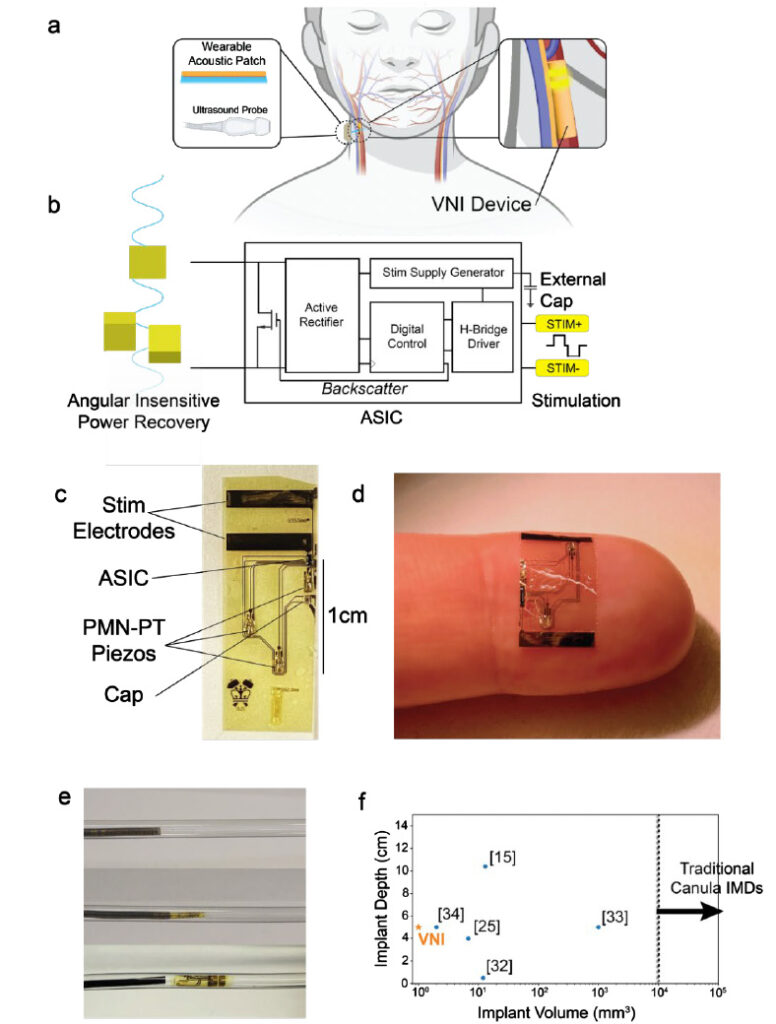
Electrical stimulation of neural circuits is expanding therapeutic strategies to modulate brain, autonomic, and immune functions. Devices delivered endovascularly offer a less invasive alternative to conventional implanted electrodes, while delivering spatio-temporal specificity superior to noninvasive techniques. We demonstrate a fully endovascular sub-1-mm3 implant, utilizing ultrasound for wireless power delivery and data telemetry in a fashion invariant to device orientation. The implant consists of piezoelectric transducers, an energy storage capacitor, an application-specific integrated circuit, and electrodes packaged on a 7-µm-thick polyimide scaffold. The implant can be delivered through a microcatheter in a manner analogous to conventional neurovascular stents, and self-expands upon deployment to appose the vessel walls. We demonstrate intravascular stimulation of the autonomic nervous system from the carotid artery, achieving modulation of blood pressure in rabbits. This approach establishes a broadly applicable platform for neural interfaces enabling both stimulation and recording.